- As labelling producer, which kind of declaration or documentation we have to do and give to our clients?
If we understand correctly, you are asking what specific compliance documentation label producers need to supply to their clients under the PPWR. The good news is that you do not need to issue the final Declaration of Conformity (DoC). This responsibility falls to the manufacturer placing the final packaged product on the market. However, you must provide your clients with technical documentation. This should include label specifications, material composition, ink and adhesive details, heavy metals and PFAS declarations, and recyclability impact data. By supplying this component-level evidence, you enable your clients to complete their own compliance obligations smoothly.
- On the importer role. What if you’re importing packed goods for your own use and your sender is not willing to support but you need their goods (unique)? Should you then make PPWR documentation for packed goods that you unpack yourself?
If we understand correctly, the question is how to handle PPWR documentation when a non-EU supplier refuses to provide compliance data for essential goods you are importing. This is a challenging scenario. Under the PPWR, an importer must verify that the non-EU manufacturer has prepared the required technical documentation. If your supplier refuses to cooperate and the goods are essential to your operations, you essentially take on the manufacturer’s responsibility. You would need to build your own technical file using available specifications, material identification, and independent testing where necessary to prove compliance.
- As packaging producer how we can declare the total content of metals and other substances due to the different components in a specific packaging? Have we do analysis on all types of packaging? Or can we calculate it?
If we understand correctly, you are asking whether packaging producers need to test every packaging type to declare compliance with limits for heavy metals, PFAS and other substances of concern. The answer is no, not in every case. The PPWR allows compliance to be demonstrated using reliable and reproducible evidence, which may include supplier declarations, material specifications, certificates of analysis, recognised standards and calculations based on a bill of materials.
A calculation can be appropriate when each component is well defined and supported by reliable data. However, if the packaging includes higher-risk materials, recycled content, coatings, inks, adhesives, multilayer structures or food-contact applications, targeted laboratory testing may be needed to close any evidence gaps and confirm that the final packaging remains within the applicable limits.
- What does it mean “Technical Validation” of Green Claims? Have the manufacters obtain a sort of certification?
Technical validation means that any environmental claim on packaging, such as recycled content, carbon neutral, or ocean friendly, must be supported by clear and reliable evidence before it is used. This could include an LCA, recognised standard, certification, or independent verification. The aim is to ensure the claim is accurate, specific, and not misleading, as vague or unsupported green claims may be considered greenwashing and could be banned under EU consumer protection rules.
- What level of information do we need to hold as a retailer and what can we ask our suppliers to hold and maintain?
As a retailer, your role under the PPWR is that of a distributor. You are not expected to hold the exhaustive technical files. However, you must exercise due diligence before selling products. This means verifying that the packaging is correctly labelled, ensuring the producer is EPR-registered, and holding a copy of the supplier’s Declaration of Conformity. The heavy lifting of maintaining detailed technical files and testing data remains with your suppliers.
- Most of our European suppliers are unwilling to provide laboratory test reports demonstrating compliance with PFAS and heavy metal limits. Instead, they provide declarations of compliance based on information from their suppliers and their own internal risk assessments. Are these declarations of compliance sufficient to demonstrate compliance with the applicable requirements?
Supplier declarations of compliance can form part of the technical documentation under Annex VII, but whether they are sufficient depends on the level of supporting evidence behind them. In many cases, a declaration supported by material specifications, supplier declarations, certificates of analysis, quality controls, and documented risk assessments may be acceptable. However, the higher the risk, such as food-contact applications, recycled content, coatings, inks, adhesives, multilayer structures, or limited supply chain traceability, may justify requesting additional evidence, including independent laboratory testing to ensure adherence to Article 5 limits.
- Our main concern is to be sure to create labels compliant documentation on SoC. Is there a sort of guidelines to follow to create it?
Currently, there isn’t a single, rigid EU template specifically for SoC documentation. Instead, you should build this into your broader technical file. The best practice is to maintain a structured record for each label construction, consolidating raw material specifications, supplier SoC declarations, and any necessary testing data.
- One of our suppliers has stated that under PPWR they will provide technical documentation only for the packaging they manufacture (e.g., shippers, cases, tubs, lids), and not for their products (e.g., syringes, stoppers). However, these products are used by us as primary packaging components in our final packaging system. Since we are responsible for demonstrating PPWR compliance of the complete packaging, we require compliance information for these components as well. How can we effectively engage such suppliers and ensure they provide the necessary documentation or supporting data needed for our PPWR compliance obligations?
If we understand correctly, you’re asking how to secure compliance data from suppliers who consider their items “products” rather than “packaging components.” Because these components function as primary packaging in your final system, you are absolutely entitled to request the compliance data needed for your Declaration of Conformity. A diplomatic approach is to offer Non-Disclosure Agreements (NDAs) or request a “limited compliance statement” that confirms PPWR adherence without revealing proprietary formulas. We also highly recommend embedding these requirements into future purchasing contracts.
- Some packaging is too small for several pieces of recycling information or pictograms. Is a QR code solution acceptable?
Yes, QR codes are generally acceptable where packaging space is limited. Article 12 provides exemptions for small packaging and allows digital solutions in certain cases. However, unless specific exemptions apply, mandatory sorting information and required pictograms may still need to appear physically on the packaging. Therefore, QR codes should be used to supplement, rather than replace, mandatory on-pack information.
- About Recyclability, have we declare the class of recyclability in our declaration of conformity? Also as a packaging components provider? If yes, how can we define the classes?
As a component provider, you do not issue the final Declaration of Conformity (DoC). This responsibility falls to the manufacturer placing the complete packaging on the market. The manufacturer will use the technical specifications you provide to calculate and declare the final recyclability performance class (A, B, or C) of the fully assembled packaging system.
- Is 2028 deadline applicable for pharma artwork to ensure compliance with PPWR waste‑sorting labelling?
Under the final implementation of the PPWR, pharmaceutical packaging is subject to specific exemptions regarding the Article 12 waste-sorting labelling requirements. While Article 12 establishes a hard 2028 deadline for most consumer packaging to bear harmonized material composition labels, recent EU guidance (June 5, 2026) clarifies that these specific waste-sorting rules do not apply to packaging targeted exclusively at specialist end-users. Thus, human or veterinary medicinal products and medical devices handled by professionals are entirely exempt from this consumer-facing sorting label requirement (Source: Packaging Europe).
- To ensure compliance with the regulation expiring on August 12, 2026, could you provide us with a draft message to send to our material suppliers? We need to formally request the necessary information from them so that, in turn, we can reassure our distributors and ultimately our end customers that the packaging fully complies with European standards. The goal is to reduce the material suppliers’ latitude for interpretation to ensure we receive the requested information.
To safeguard your compliance, you need to request a precise, non-negotiable checklist from suppliers. You should formally request their material specifications, REACH/SVHC/PFAS declarations, heavy metal test reports, and Design for Recycling (DfR) assessments. Generic statements will not suffice. We highly recommend reaching out to us at Packfora, and we can help you draft these exact supplier communications.
- As packaging (labels) producer point of view, could you provide a draft message to send to our raw material suppliers?
Your message should explicitly ask for Material Specifications, Safety Data Sheets, Food Contact Declarations, and test reports for heavy metals and PFAS for all adhesives, inks, and facestocks. We’d be happy to share a tailored draft template with you to ensure you get exactly what you need—just reach out to our consulting team at Packfora.
- Good afternoon. Were can i find a PPWR EU DoC template?
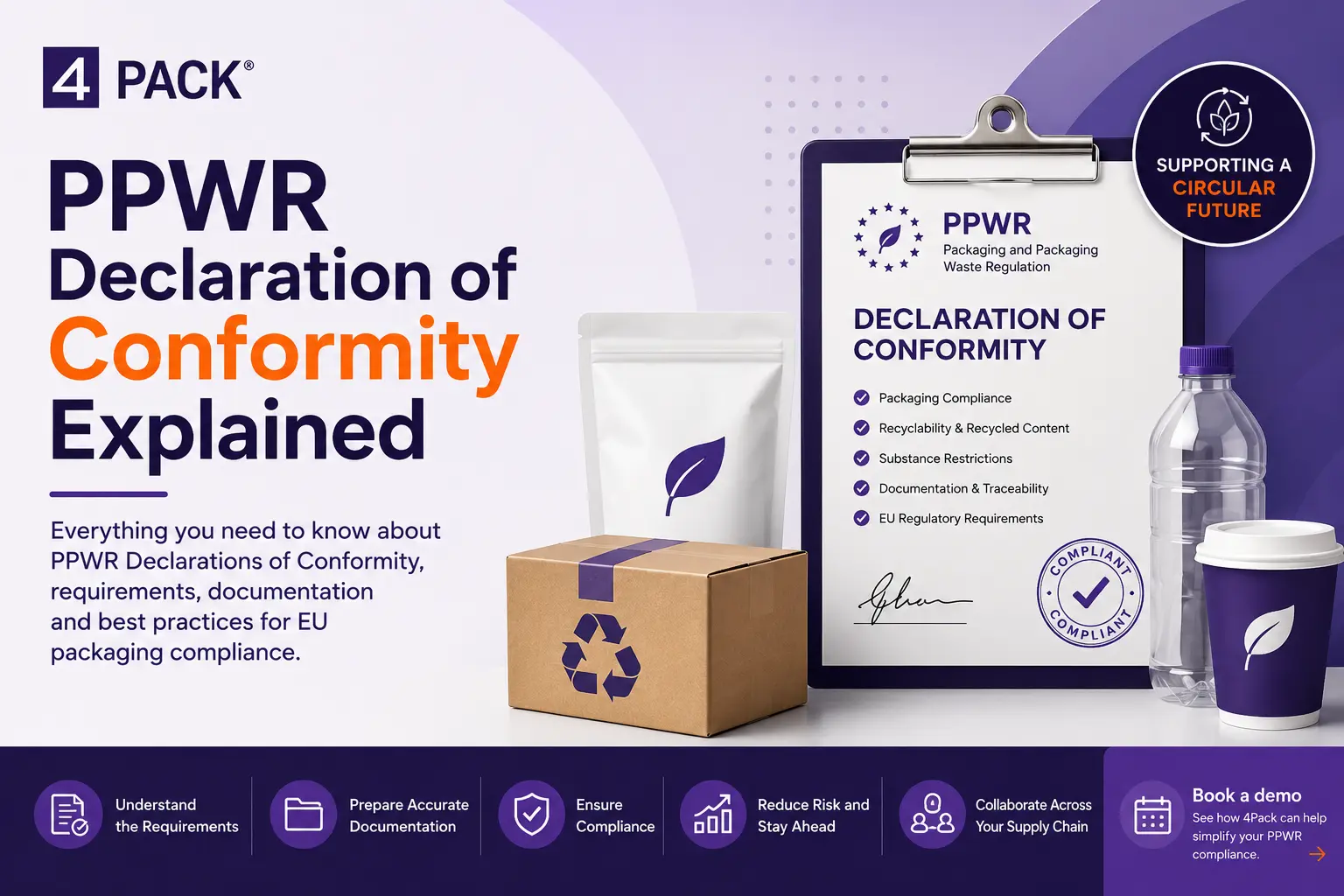
Currently, there isn’t a single, official EU-issued template for the PPWR DoC. However, the exact structure and mandatory data points you must include are strictly defined in Annex VIII of the regulation. You can create your own document based on those requirements. If you’d like a reliable, compliant starting point, the Packfora team can provide a template tailored specifically to your business.
- If you sell directly online or to foreign end-users, you must register with the EPR registry of each individual Member State you ship to (such as LUCID in Germany or ADEME in France), as you are considered the first importer in that territory. How do you do this?
As EPR registration remains decentralized and no single EU-wide portal, you must engage with the designated Producer Responsibility Organisation (PRO) or national authority of each specific MS to establish a separate compliance profile and pay national fees for every individual market you enter. Additionally, Article 45 strictly governs EPR for cross-border D2C sales, legally requiring foreign companies to appoint an Authorized Representative established within their territory. Ultimately, your compliance liability dictates that you must secure these local representatives and obtain your unique EPR numbers before shipping, as Article 45 mandates that online marketplaces verify your registration and will immediately block non-compliant sellers from the market.
Need further support? Navigating the technical, legal, and operational nuances of the PPWR can be complex. At the end of the day, ensuring your packaging portfolios and supply chains are fully compliant requires precise strategy and verified data.
Whether you need help drafting supplier mandates, identifying the right test houses for PFAS and heavy metals, engaging legal firms for cross-border EPR representation, or building your Annex VII technical files, Packfora is here to help.
Visit us at www.packfora.com or reach out directly to our consulting team (Supriya Mantri / Ankheeta Lath), and we will guide you through the exact specific details for your business.
Looking for a better way to manage your packaging compliance data?
Understanding the regulation is only part of the challenge. As PPWR requirements continue to evolve, managing supplier information, technical documentation and Declarations of Conformity across your packaging portfolio can quickly become complex.
4Pack helps organisations centralise their packaging information, manage supplier data and maintain the information needed to support ongoing PPWR compliance. From supplier documentation and technical specifications to packaging records and Declaration of Conformity processes, 4Pack provides a single source of trusted packaging data.
To find out how 4Pack can help simplify your packaging compliance processes, contact Helen.poole@4-flying.com 0r visit www.4-pack.com to book a demo with one of our specialists.