Introduction
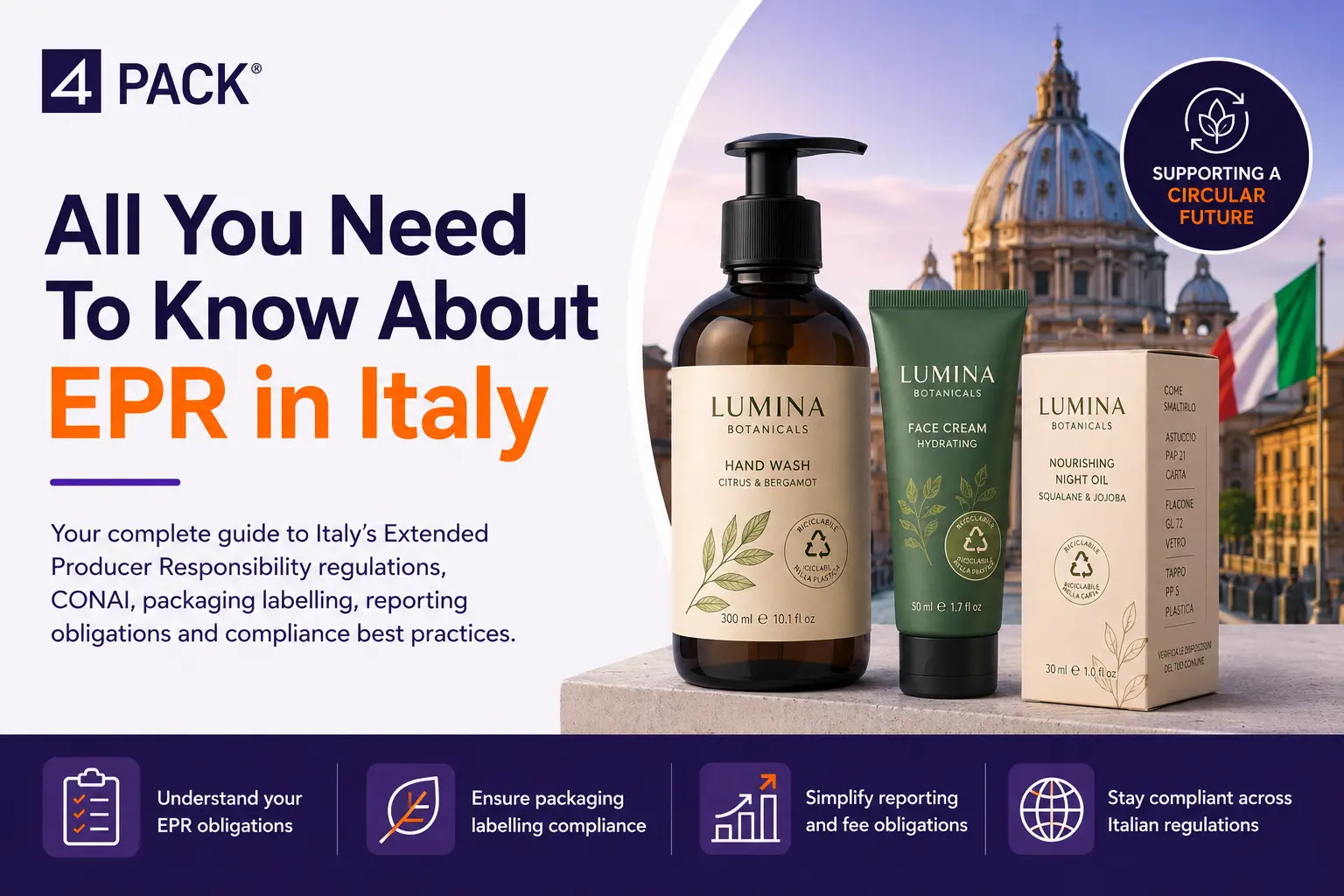
If your business manufactures, imports or sells packaged goods in Italy, understanding Extended Producer Responsibility (EPR) is essential. Italy operates one of Europe’s most established packaging compliance systems, requiring businesses to take responsibility for the packaging they place on the market throughout its lifecycle.
As sustainability regulations continue to evolve across the European Union, businesses must ensure they understand their legal obligations and have the right processes in place to manage packaging data, environmental labelling and reporting requirements. Failure to comply can result in financial penalties, delays to product launches and unnecessary operational challenges.
Whether you’re an Italian manufacturer, an overseas exporter or an online retailer supplying customers in Italy, this guide explains everything you need to know about EPR in Italy. We’ll explore who must comply, how the Italian EPR system works, packaging labelling requirements, registration obligations and how software such as 4Pack can simplify compliance.
What is EPR in Italy?
Understanding Extended Producer Responsibility
Extended Producer Responsibility, commonly known as EPR, is an environmental policy that makes businesses responsible for the packaging they introduce onto the market. Instead of local authorities covering the full cost of collecting and recycling packaging waste, producers contribute towards these costs through national compliance schemes.
The principle encourages organisations to think beyond the point of sale. Businesses are expected to consider how packaging is designed, what materials are used and how easily those materials can be recycled once the product reaches the end of its life.
For manufacturers and brand owners, EPR is about far more than paying environmental fees. It also encourages better packaging design, greater transparency throughout the supply chain and more sustainable decision-making.
Why Italy Introduced EPR Regulations
Italy introduced its EPR framework to support wider European sustainability objectives, including the EU Packaging and Packaging Waste Directive and the Circular Economy Action Plan. These initiatives aim to reduce waste, increase recycling rates and encourage manufacturers to minimise the environmental impact of packaging.
Like many European countries, Italy has committed to ambitious recycling targets. Achieving these targets requires producers to play an active role in funding recycling infrastructure while reducing unnecessary packaging and increasing the use of recyclable materials.
The Italian system has evolved over many years and is now recognised as one of Europe’s most comprehensive packaging recovery schemes. Businesses introducing packaging onto the Italian market are expected to understand their responsibilities from the outset rather than treating compliance as an afterthought.
How EPR Supports the Circular Economy
Traditional economies often follow a simple pattern of producing, using and disposing of products. A circular economy takes a different approach by keeping materials in use for as long as possible through reuse, recycling and recovery.
Italy’s EPR system helps support this model by ensuring businesses contribute financially towards collecting and recycling packaging after it has been used. The funding generated through environmental contributions helps maintain national recycling infrastructure while encouraging producers to develop packaging that is easier to recycle.
For businesses, adopting circular economy principles can also create commercial benefits. More sustainable packaging can reduce material usage, improve brand perception and help organisations prepare for future environmental legislation across Europe.
Who Needs to Comply with EPR in Italy?
Manufacturers and Packaging Producers
Many businesses assume EPR only affects companies that manufacture packaging. While producers play a significant role, the legislation applies much more broadly.
Manufacturers producing packaged goods for the Italian market are generally responsible for ensuring those products comply with national packaging regulations. This includes understanding the materials used, maintaining accurate packaging specifications and meeting any applicable reporting obligations.
Businesses producing packaging itself, including containers, cartons and transport packaging, may also have responsibilities depending on how products are supplied throughout the value chain.
Understanding where responsibility begins is one of the first steps towards maintaining compliance.
Importers and Brand Owners
Importers introducing packaged goods into Italy also have obligations under the country’s EPR legislation. Even if products were manufactured overseas, responsibility often transfers to the organisation placing those goods onto the Italian market.
Brand owners should also review their responsibilities carefully. If products are sold under your company’s brand name, you may remain responsible for packaging compliance even when manufacturing is outsourced to third-party suppliers.
This is particularly relevant for retailers operating private-label ranges or businesses working with contract manufacturers. Outsourcing production does not necessarily outsource compliance.
Maintaining visibility over packaging specifications and artwork is therefore essential for ensuring products continue to meet Italian requirements.
Overseas Businesses Selling into Italy
The growth of cross-border eCommerce has increased the number of overseas businesses affected by Italian EPR legislation.
Companies selling directly to Italian consumers through their own websites or online marketplaces may still have compliance obligations, even if they have no physical presence in Italy. Depending on how products enter the market, registration and reporting requirements may still apply.
Because international supply chains vary considerably, overseas businesses should review their distribution model before entering the Italian market. Taking time to understand responsibilities early helps prevent unexpected compliance issues and reduces the risk of costly corrective action later.
Which Packaging is Covered by Italian EPR?
Primary, Secondary and Tertiary Packaging
Italian EPR legislation applies to virtually every type of commercial packaging placed on the market. The rules extend beyond the packaging consumers see on shop shelves and also include packaging used throughout transportation and distribution.
Primary packaging is the packaging that comes into direct contact with the product. Examples include bottles, jars, cartons, trays, wrappers and flexible pouches. This is often the packaging consumers interact with first and is typically subject to environmental labelling requirements.
Secondary packaging groups products together for retail sale or display. Multipacks, display boxes and promotional sleeves all fall within this category.
Tertiary packaging protects products during storage and transportation. Pallets, shrink wrap, transit cartons, protective films and other transport materials are also covered by Italian EPR legislation.
Businesses should review every packaging component individually rather than viewing products as a single unit.
Packaging Materials Included
Italy’s EPR scheme covers all major packaging materials, including plastic, paper and cardboard, glass, steel, aluminium, wood and composite materials.
Each material must be correctly classified because environmental contributions vary depending on the material type and its recyclability. Composite packaging can present particular challenges because different components may require separate classification.
For example, a ready meal might include a plastic tray, cardboard sleeve, plastic film and adhesive label. Although these components form a single retail product, each material must be identified correctly for reporting and environmental labelling purposes.
Maintaining accurate packaging specifications becomes increasingly important as product ranges grow. Businesses relying on disconnected spreadsheets or outdated documentation often find it difficult to maintain consistent information across every packaging component.
How Does Italy’s EPR System Work?
The Role of CONAI
Italy’s packaging EPR system is coordinated by CONAI, officially known as the Consorzio Nazionale Imballaggi. CONAI oversees the country’s packaging recovery and recycling framework, helping businesses fulfil their environmental responsibilities while supporting national recycling targets.
Most businesses introducing packaging onto the Italian market are required to join CONAI unless a specific exemption applies. Membership enables producers to contribute towards the cost of collecting, sorting and recycling packaging waste throughout Italy.
CONAI works alongside six material-specific consortia responsible for plastic, paper, glass, aluminium, steel and wood packaging. These organisations coordinate recycling activities for their respective materials and play an important role in helping Italy meet European sustainability objectives.
Understanding the Environmental Contribution (CAC)
Businesses registered with CONAI pay an Environmental Contribution known as the Contributo Ambientale CONAI (CAC).
This contribution helps finance Italy’s recycling infrastructure and is calculated according to factors such as packaging material, weight and classification. In some cases, recyclability also influences the contribution rate, providing an incentive for businesses to adopt more sustainable packaging designs.
Contribution rates are reviewed periodically, meaning businesses should regularly monitor updates to ensure calculations remain accurate. Using outdated classifications or incorrect packaging data can result in inaccurate declarations and unnecessary costs.
Why Accurate Packaging Data Matters
Accurate packaging information sits at the heart of successful EPR compliance.
Businesses need reliable records covering packaging specifications, material compositions, weights and approved artwork. Without this information, preparing declarations becomes significantly more difficult, particularly when managing hundreds or thousands of SKUs.
Many organisations still store packaging information across multiple spreadsheets, email chains and shared drives. This fragmented approach increases the likelihood of inconsistent data, duplicated work and reporting errors.
By centralising packaging specifications and maintaining robust version control, businesses can simplify reporting, improve collaboration and reduce the risk of non-compliance as regulations continue to evolve.
Italian Packaging Labelling Requirements
Why Environmental Labelling Matters
Environmental labelling is one of the most important aspects of EPR compliance in Italy. While reporting and environmental contributions help fund the country’s recycling infrastructure, packaging labels play a vital role in helping consumers dispose of waste correctly.
Italy introduced mandatory environmental labelling requirements to improve recycling rates and support the country’s circular economy objectives. By providing clear information about packaging materials and disposal methods, businesses help consumers make informed decisions while reducing contamination within recycling streams.
For manufacturers and brand owners, environmental labelling should not be viewed as a standalone compliance exercise. Instead, it should form part of a wider packaging governance process that includes artwork management, regulatory reviews and version control. A seemingly minor error on a packaging label can result in thousands of products requiring rework, delaying launches and increasing production costs.
Embedding compliance checks into artwork approval workflows is therefore one of the most effective ways to reduce risk and ensure packaging consistently meets Italian requirements.
Material Identification Codes
One of the key requirements for packaging sold in Italy is the use of appropriate material identification codes. These codes identify the material used in each packaging component and are based on the classification system established under European Decision 97/129/EC.
Different materials have their own identification codes, allowing consumers and waste management operators to recognise whether a component is made from plastic, paper, glass, aluminium, steel, wood or composite materials. Products containing multiple packaging components often require several material codes, as each component should be identified individually.
For example, a beverage carton may include a paper-based outer layer, a plastic cap and an aluminium lining. Each component should be classified correctly to support accurate recycling and compliance reporting.
Using incorrect material codes can create confusion for consumers and may lead to packaging failing to meet regulatory expectations. Businesses should therefore ensure that packaging specifications and artwork files are updated whenever materials or packaging designs change.
Disposal Instructions for Consumers
In addition to material identification codes, many consumer-facing products must include clear disposal instructions that explain how packaging should be discarded after use.
The wording and presentation of these instructions should be easy to understand and encourage consumers to separate packaging into the correct recycling streams. Clear guidance helps improve recycling rates while reducing contamination caused by incorrectly sorted waste.
Businesses should remember that disposal instructions may need reviewing whenever packaging materials are updated. If a plastic component is replaced with a paper alternative, for example, the disposal guidance should also be revised to reflect the change.
Accurate disposal information depends on effective collaboration between regulatory, packaging and design teams. When these departments work from different versions of artwork or packaging specifications, inconsistencies can easily arise.
Common Packaging Labelling Mistakes
Many packaging compliance issues stem from relatively simple mistakes that could have been avoided through stronger artwork governance.
One common problem is the use of outdated artwork files following regulatory updates. Businesses may also overlook packaging variants, resulting in some products displaying correct environmental information while others continue using obsolete labels.
Incorrect material classifications, missing disposal instructions and inconsistent translations are also frequent causes of non-compliance, particularly for organisations selling products across multiple European markets.
Implementing structured approval workflows significantly reduces these risks. Every packaging update should undergo a regulatory review before being approved for production, ensuring environmental information remains accurate across every SKU.
How to Register for EPR in Italy
Determining Whether You Need to Register
Before placing packaged goods on the Italian market, businesses should determine whether they have registration obligations under Italy’s EPR framework.
Responsibility depends on the role a business plays within the supply chain. Manufacturers, importers, brand owners and certain overseas businesses may all have obligations depending on how products are supplied. Organisations should therefore review their business model carefully rather than assuming compliance responsibilities sit elsewhere.
Understanding your obligations before launching products in Italy helps avoid unnecessary delays and ensures compliance processes are established from the outset.
Registering with CONAI
Many businesses required to comply with Italian packaging regulations will need to register with CONAI.
The registration process typically involves providing company information, VAT details and information about the packaging materials that will be introduced onto the Italian market. Businesses may also need to provide estimates of packaging volumes, depending on their activities.
Registration is only the beginning of the compliance journey. Once registered, businesses become responsible for ongoing reporting and environmental contributions, making accurate packaging data essential throughout the year.
Preparing for Ongoing Reporting
Successful reporting begins long before submission deadlines arrive.
Businesses should maintain accurate records covering packaging materials, weights, approved specifications and supplier information. Collecting this information as products are developed is significantly easier than attempting to reconstruct it later for reporting purposes.
Organisations with centralised packaging management systems are often better positioned to meet reporting deadlines because the information they need is already available in one place. This reduces manual administration while improving the accuracy of declarations.
EPR Fees and Reporting Obligations
How Environmental Contributions Are Calculated
Businesses placing packaging on the Italian market are generally required to pay environmental contributions through CONAI. These fees help fund the country’s recycling and recovery infrastructure and ensure producers contribute towards the cost of managing packaging waste.
Contribution levels depend on several factors, including the packaging material, its weight and, in some cases, its recyclability. Because rates are reviewed periodically, businesses should regularly monitor updates to avoid relying on outdated fee structures.
Even relatively small inaccuracies in packaging data can have a significant financial impact when multiplied across hundreds or thousands of products.
Understanding Reporting Requirements
Reporting obligations vary depending on the size of the business and the amount of packaging introduced onto the market.
Some organisations are required to submit declarations monthly, while others may report quarterly or annually. Whatever the reporting frequency, maintaining accurate packaging information throughout the year makes compliance considerably easier.
Businesses should establish internal processes that allow packaging data to be updated whenever products change. Waiting until reporting deadlines approach often leads to unnecessary pressure and increases the likelihood of errors.
The Importance of Good Record Keeping
Strong record keeping forms the foundation of successful EPR compliance.
Businesses should retain packaging specifications, material classifications, artwork files, supplier information and previous declarations. These records support accurate reporting and provide valuable evidence if regulators request additional information.
A centralised approach to packaging management also improves collaboration between departments. Rather than relying on multiple spreadsheets and email chains, teams can work from a single source of truth that reflects the latest approved information.
This not only supports compliance but also improves operational efficiency across the wider packaging lifecycle.
Penalties for Non-Compliance
Financial and Regulatory Consequences
Failure to comply with Italy’s EPR regulations can expose businesses to financial penalties and increased regulatory scrutiny.
Organisations that fail to register, submit inaccurate declarations or neglect to pay environmental contributions may face enforcement action. While the level of any penalty depends on the specific circumstances, resolving compliance issues often requires considerable time and resources.
Avoiding these situations is far easier than correcting them once products have entered the market.
Commercial Risks Beyond Fines
The impact of non-compliance extends beyond financial penalties.
Retailers, distributors and supply chain partners increasingly expect suppliers to demonstrate that packaging complies with applicable regulations. Delays caused by incorrect artwork or incomplete documentation can disrupt product launches and damage valuable commercial relationships.
Businesses operating across several European markets may also find that weaknesses in one country’s compliance processes expose wider governance issues throughout the organisation.
Protecting Your Brand Reputation
Consumers are placing greater importance on sustainability than ever before.
Businesses that demonstrate strong environmental governance and transparent packaging practices are more likely to build trust with customers, retailers and investors. Conversely, compliance failures can undermine a company’s reputation and create unnecessary negative publicity.
Developing robust compliance processes therefore delivers both regulatory and commercial benefits.
Common Challenges Businesses Face with Italian EPR
Managing Complex Packaging Portfolios
As product portfolios expand, so does the complexity of EPR compliance. Many businesses no longer sell a handful of products. Instead, they manage hundreds or even thousands of Stock Keeping Units (SKUs), each with unique packaging specifications, materials and artwork.
A single product may contain several packaging components, including a plastic container, cardboard sleeve, adhesive label and tamper seal. Each component may need to be classified separately for reporting purposes and require different environmental labelling. When multiplied across an entire product range, maintaining accurate records becomes a significant challenge.
Businesses launching seasonal products or introducing regular packaging updates face even greater complexity. Without clear processes and centralised packaging information, it becomes increasingly difficult to ensure every product remains compliant.
Keeping Pace with Regulatory Changes
Packaging legislation continues to evolve across both Italy and the wider European Union. Changes to environmental labelling requirements, reporting obligations or environmental contribution rates can affect businesses with little notice.
For organisations operating in multiple countries, keeping track of different national requirements can become a full-time responsibility. Italy’s EPR framework may differ from those in France, Germany or Spain, meaning businesses cannot simply apply the same compliance process across every market.
Regularly reviewing legislative updates and maintaining close communication between regulatory, packaging and product teams helps businesses respond more quickly to changing requirements.
Maintaining Accurate Packaging Data
Reliable packaging data is essential for successful EPR compliance, yet many organisations still struggle to maintain a single, accurate source of information.
Packaging specifications are often stored in different systems across regulatory, procurement, design and manufacturing teams. Artwork files may exist in multiple versions, while packaging weights and material classifications are maintained in separate spreadsheets. This fragmented approach increases the likelihood of inconsistencies and makes reporting more time consuming.
Centralising packaging information allows businesses to improve data accuracy, reduce duplication and ensure everyone works from the latest approved specifications.
Improving Cross-Department Collaboration
Packaging compliance rarely sits within a single department. Regulatory specialists, designers, marketing teams, procurement managers, packaging engineers and external suppliers all play a role in developing and approving packaging.
Without structured workflows, important information can easily be overlooked during the approval process. Regulatory changes may not be communicated to designers, while updated artwork may not reach suppliers before production begins.
Establishing clear approval workflows and maintaining visibility across every stage of the packaging lifecycle helps reduce errors while improving collaboration between internal teams and external partners.
Best Practices for Staying Compliant
Conduct Regular Packaging Reviews
One of the most effective ways to maintain compliance is by reviewing packaging on a regular basis rather than waiting until legislation changes.
Routine audits allow businesses to confirm packaging materials remain correctly classified, environmental labels are accurate and artwork reflects current regulatory requirements. They also provide an opportunity to identify packaging that could be redesigned to improve recyclability or reduce material usage.
Regular reviews become particularly valuable for businesses with extensive product portfolios, where older packaging designs may continue to circulate long after new standards have been introduced.
Create a Single Source of Truth
Successful compliance depends on accurate information.
Maintaining one central location for packaging specifications, artwork, material classifications and regulatory documentation ensures every department works from the same approved information. This eliminates confusion caused by duplicate files and outdated documentation while improving confidence in reporting data.
A centralised approach also makes it easier to respond to audits, regulatory enquiries and customer requests for packaging information.
Build Compliance into Artwork Approval
Compliance should never be treated as the final step before printing. Instead, it should be integrated into the artwork approval process from the beginning.
Every packaging revision should pass through structured review stages involving the relevant stakeholders, including regulatory, quality assurance and packaging teams. This ensures mandatory environmental information, material identification codes and legal statements are verified before artwork is approved for production.
Embedding compliance within existing workflows reduces the likelihood of errors while avoiding costly reprints and production delays.
Invest in Digital Packaging Management
Manual processes become increasingly difficult to manage as businesses grow.
Digital packaging management platforms help organisations centralise documentation, automate approvals and maintain complete version histories for every packaging asset. This not only improves compliance but also enhances collaboration, reduces administrative effort and accelerates product launches.
For businesses managing packaging across several international markets, digital systems provide the visibility needed to maintain consistent standards while adapting quickly to regulatory change.
How 4Pack Helps You Stay Compliant with EPR in Italy
Centralise Your Packaging Information
Managing packaging compliance is significantly easier when every specification, artwork file and regulatory document is stored in one secure location.
4Pack provides a centralised platform that enables businesses to manage packaging information throughout the entire product lifecycle. Rather than searching through shared drives, spreadsheets and email chains, teams can access the latest approved documentation whenever they need it.
Having a single source of truth improves accuracy, reduces duplication and gives every stakeholder confidence that they are working from the correct information.
Strengthen Artwork Approval and Version Control
Packaging artwork is constantly evolving. Marketing updates, regulatory changes and product improvements all require revisions that must be carefully managed.
4Pack streamlines artwork approval by providing structured workflows that route designs through the appropriate reviewers before production. Every comment, amendment and approval is recorded, creating a complete audit trail that supports both compliance and quality assurance.
Strong version control also reduces the risk of outdated artwork being printed, helping businesses avoid expensive rework and unnecessary delays.
Support More Accurate Compliance
Accurate reporting starts with accurate data.
By linking packaging artwork, specifications and product information within a single platform, 4Pack helps businesses maintain the consistency needed for effective EPR compliance. Regulatory teams can quickly verify packaging details, while designers have immediate access to approved artwork and mandatory compliance information.
This collaborative approach reduces manual administration, improves reporting accuracy and minimises the risk of packaging reaching the market with incorrect environmental information.
Simplify Compliance Across Multiple Markets
Many organisations sell products throughout Europe, meaning they must comply with multiple EPR schemes simultaneously.
4Pack helps businesses standardise packaging management processes across different countries while maintaining the flexibility needed to accommodate local regulatory requirements. This allows teams to manage complex packaging portfolios more efficiently and respond quickly as legislation evolves.
Whether you’re expanding into Italy or already managing packaging across several international markets, 4Pack provides the tools needed to improve governance, strengthen collaboration and reduce compliance risk.
Book a Demo with 4Pack
Staying compliant with Italy’s EPR regulations requires more than accurate reporting. It depends on having reliable packaging data, effective artwork approval processes and clear visibility across every stage of the packaging lifecycle.
If your business is looking to improve packaging governance and simplify compliance, book a demo with 4Pack. We’ll show you how our platform helps manufacturers, brand owners and retailers centralise packaging information, streamline approvals and stay compliant with evolving packaging regulations across Europe.
Frequently Asked Questions About EPR in Italy
Is EPR mandatory in Italy?
Yes. Businesses that place packaging on the Italian market are generally subject to Extended Producer Responsibility obligations. The exact requirements depend on your role within the supply chain, but manufacturers, importers, brand owners and some overseas businesses may all have compliance responsibilities.
What is CONAI?
CONAI, or Consorzio Nazionale Imballaggi, is Italy’s National Packaging Consortium. It coordinates the country’s packaging recovery and recycling system, manages environmental contributions and works with specialist material consortia to improve recycling performance across Italy.
Do overseas businesses need to comply?
In many cases, yes. Companies based outside Italy that sell packaged goods directly into the Italian market may still have registration and reporting obligations. Businesses should review their distribution model carefully to determine their responsibilities before trading.
How are EPR fees calculated?
Environmental contributions are typically based on the type of packaging material, its weight and the relevant classification used within the Italian EPR system. Because contribution rates are reviewed periodically, businesses should ensure they use the latest information when preparing declarations.
What packaging requires environmental labelling?
Many consumer-facing packaging formats require environmental labelling that identifies packaging materials and provides disposal instructions. The exact requirements depend on the packaging type and how the product is supplied, making accurate artwork management essential for maintaining compliance.
How can businesses simplify EPR compliance?
The most effective approach is to centralise packaging information, maintain accurate specifications, implement structured artwork approval workflows and regularly review regulatory changes. Digital packaging management software such as 4Pack can help businesses automate many of these processes while improving visibility across their entire packaging portfolio.
Summary
Italy’s Extended Producer Responsibility framework is a key part of the country’s strategy to reduce packaging waste and support a more circular economy. While the regulations can appear complex, businesses that invest in strong packaging governance are better equipped to meet their obligations and adapt to future legislative changes.
Compliance involves much more than registering with CONAI or paying environmental contributions. Businesses must maintain accurate packaging data, ensure environmental labelling is correct, manage artwork revisions effectively and submit reliable declarations throughout the year. Achieving this consistently requires collaboration between regulatory, packaging, design and manufacturing teams.
As packaging portfolios grow and regulations continue to evolve, manual processes become increasingly difficult to manage. Centralising packaging information and introducing structured approval workflows can significantly reduce compliance risks while improving operational efficiency.
4Pack helps businesses bring every aspect of packaging management together in one place. From artwork approval and version control to packaging specifications and regulatory documentation, our platform gives teams the visibility and control they need to stay compliant with confidence.
Book a demo with 4Pack today to discover how we can help your business simplify EPR compliance in Italy, improve collaboration and manage packaging more effectively across every market in which you operate.