Most businesses can say what packaging compliance costs them. Few can say what failing to comply would cost. The answer is usually higher than expected, and fines are only the start.
Packaging non-compliance can pull products off shelves, block sales in whole markets and tie up your team for months. It can also happen quietly, through one wrong figure on a data sheet or one out-of-date label. This article explains the real cost of packaging non-compliance, from the visible penalties to the hidden losses. It also shows where the problem usually begins.
Fines and Penalties: The Visible Cost
Penalties are the cost most people think of first. They differ by country and by the obligation breached. For instance:
- UK: Under packaging extended producer responsibility (EPR), administrative breaches can bring a fixed penalty of £1,000. Large producers that miss a fee payment by more than 50 days can face a penalty of the higher of 20% of the unpaid fees or 5% of UK turnover.
- EU: The Packaging and Packaging Waste Regulation (PPWR) applies from 12 August 2026 with requirements phased in . It leaves the exact penalties to each member state, but they must be effective, proportionate and dissuasive.
- Germany: Failing to participate in a licensed packaging scheme when required can cost up to €200,000. Placing packaging on the market without registering can cost up to €100,000.
- Italy: Placing packaging on the market without the required environmental label can bring a fine of €5,200 to €40,000.
- US: California’s EPR rules allow penalties of up to $50,000 per day per violation.
Enforcement varies by country. The PPWR gives member states until 12 February 2027 to establish and notify their penalty rules, while existing national packaging obligations remain relevant during the transition. Waiting for clarity is a risky plan.
These sums hurt. But for many businesses, fines are the smaller bill.
The Hidden Costs That Hurt More
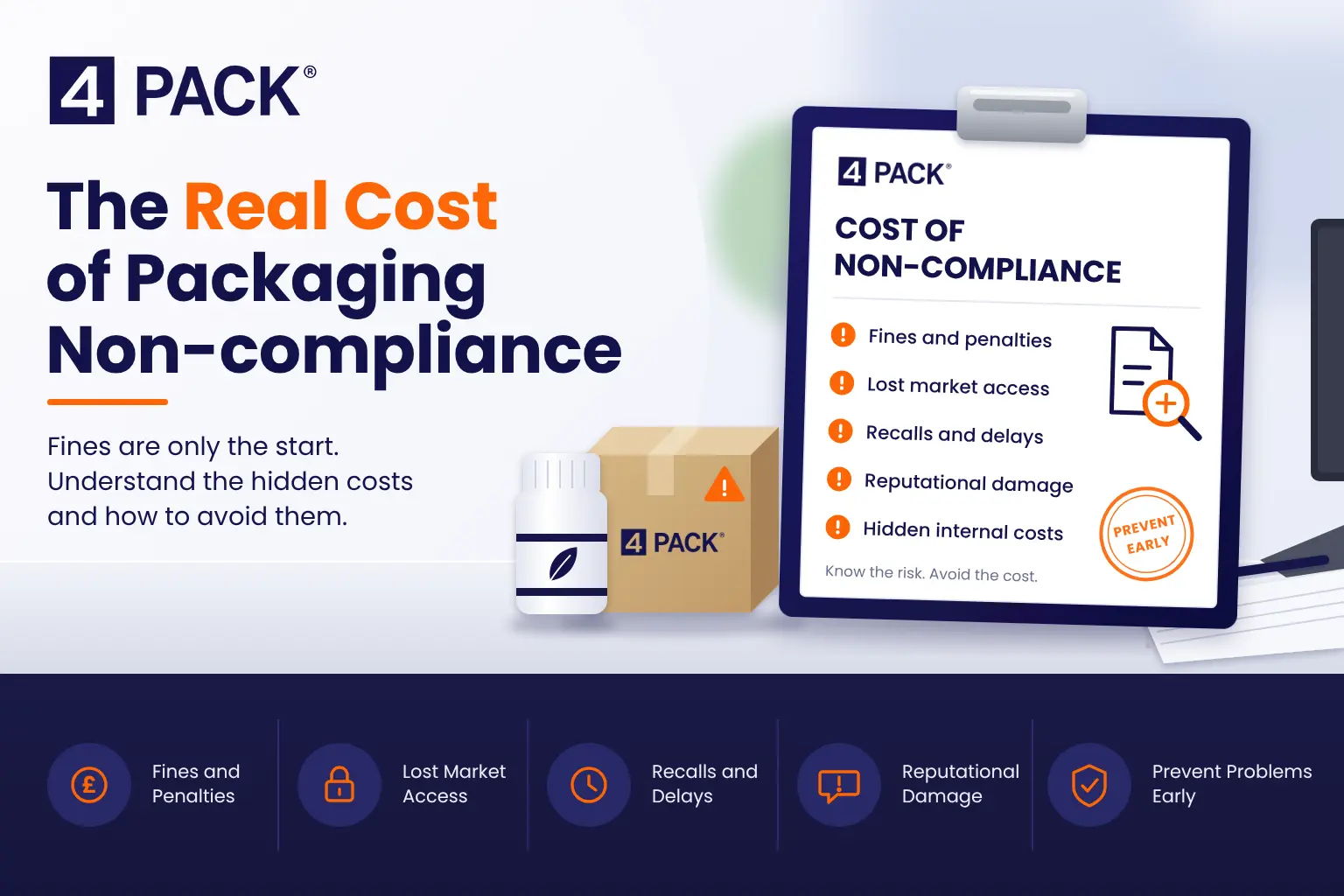
Losing access to a market can cost far more than any fine. The damage also spreads well beyond the finance team.
- Pulled products. Authorities can require packaging or packaged goods to be withdrawn or recalled. Stock then sits idle while storage and transport costs build.
- Delisted online. EU online marketplaces block listings that lack a valid packaging registration number. For online sellers, this is often where the problem shows first.
- Delays and rejected shipments. Non-compliant packaging can cause customs delays, and shipments can be turned away at the border.
- Redesign and relabelling. Fixing packaging after launch costs far more than getting it right at the design stage.
- Reputation. In the UK, for example, the Environment Agency can publicly name firms that break the rules.
- Lost time. Teams spend weeks chasing data and correcting errors instead of doing their jobs.
These costs also stack up. A recall brings storage fees, lost sales and legal time. A delisting brings lost revenue and strained retail relationships. Each one is hard to predict, which makes non-compliance very difficult to budget for.
Picture a product ready to ship to three markets. The artwork carries an out-of-date recycling claim, and the packs are already printed. The line stops, the artwork is redone, and the launch slips by weeks. No fine was issued, yet the cost is real.
One Product, Many Rulebooks
If you sell across borders, a single pack can face several sets of rules at once.
In the UK, packaging EPR sits alongside the plastic packaging tax. In the EU, the PPWR applies directly, alongside national implementation and enforcement rules and transitional requirements. In the US, state EPR laws keep spreading. Each regime has its own reporting, labelling and fee requirements.
A pack that passes in one market can fail in another. UK firms selling into Europe must meet two different systems, and they cannot treat them as one.
The rules also keep moving. UK EPR fees now vary with how recyclable your packaging is, and EU requirements phase in over several years. A pack that is compliant today may not be next year.
Where Packaging Non-compliance Usually Starts
It rarely starts with bad intent. It starts with data.
Packaging details often sit in spreadsheets, supplier emails and separate departments. Material weights, recycled content and recyclability claims go out of date. Artwork is approved against one version of the facts while the specification holds another.
Nobody spots the gap until an audit, a retailer check or a customs inspection. By then, fixing it is slow and expensive.
The risk also travels along your supply chain. Brand owners and importers can be exposed to their suppliers’ failures, so one weak link can put your products at risk.
How to Reduce Your Exposure to Packaging Non-compliance
You cannot remove the risk entirely, but you can shrink it. Start here:
- Map your markets. List where you sell and which rules apply in each.
- Centralise your data. Keep product and packaging data in one place, not scattered across spreadsheets.
- Check before you print. Compare artwork and claims against specifications before they go to press.
- Hold suppliers to account. Ask for accurate data and check it when it arrives.
- Review often. Rules change, so your checks should too. Prevention is always cheaper than correction.
The Bottom Line
The real cost of packaging non-compliance is rarely a single number. It is a mix of fines, lost sales, wasted stock and lost time, and much of it never appears on a budget line. Businesses that treat packaging data as a core asset spot problems early and fix them cheaply. Those that don’t often find out the hard way.
See Where Your Risk Sits
4Pack helps manufacturers manage product and packaging data and artwork in one cloud-based platform. We can help ensure compliance checks happen before problems reach the shelf, not after. Book a demo to see how it works.